









Moczygemba and more Musings . . .
Today was my first day at a new gate called Moczygemba, and I even learned how to pronounce it . . . from a family member.
It’s ‘moxie gim ba’ with no accent on anything.
It was a slow rainy day, with only 7 people coming in and out. And it never got above about 55 so I was really glad I took one of my small heaters with me. So far I’ve found that the heater part of these shack’s AC units doesn’t work very well, but I was warm and toasty with my own.
Responding to some recent articles, I’ve come up with another one of my Musings, or maybe rants. You be the judge.
In the next day or so, I’ll post a cleaned-up version in the Greg’s Musings area.
Frederick Douglass, The 3/5 Compromise, and our ‘racist’ Constitution
Since the Electoral College win for Trump, I’ve seen a number of online articles about how the Electoral College is outmoded, outdated, old-fashioned, antiquated, obsolete, even antediluvian, you pick your favorite, and that the EC should be scrapped and the Presidential Election should be decided by the popular vote.
But the most egregious are the ones saying that the Electoral College should be abolished because it, and the Constitution, are ‘racist’. So by extension, the Founding Fathers were racists too.
Those of you who read my previous screeds under Greg’s Musings, “The Electoral College – Why?” and “The 1960 World Series and the Electoral College” know why the Founding Fathers set up the Electoral College the way it is.
If not, go read those two articles and then come back.
We’ll wait.
OK, now.
So where does the whole ‘racist’ thing come from, besides the fevered imagination of some Beltway pundit? At this point, all the fingers seem to point toward the much-discussed “3/5 Compromise”.
The first ‘Constitution’, the Articles of Confederation, or more properly, the Articles of Confederation and Perpetual Union, was essentially a war-time Constitution, drafted starting in July 1776. But it wasn’t sent to the states for ratification until in late 1777, and not finally ratified by all 13 states until March 1, 1781.
Things ran slower back then.
While the Articles did OK allowing the government to fight the Revolutionary War and conduct diplomacy with other nations, it quickly started unraveling at the seams after the war ended. Mostly because the Articles did not give the government much in the way of power, leaving the individual states in real control. For example, the government under the Articles could not levy taxes for money to actually run the government. They had to ask the states to ‘pretty please’ give us some money.
You can imagine how well that worked.
George Washington complained that Congress was paralyzed because nothing could be done without the states joining in. And they were never in any hurry to do anything. That’s why it took over 3 years for the Articles to even be ratified to start with. And even The Treaty of Paris, ending the Revolutionary War, laid around for months before it was finally ratified by all the states because several state’s representatives just didn’t show up to vote, and there was no way to make them.
Most of this foot-dragging ratification problem of the Articles was due to how much land some states were claiming out west. Virginia, for instance, tried to claim pretty much the height of the state all the way to the west coast, one long 2000+ mile strip. Because of all this contention, it was two years between when the 12th state, Delaware, ratified the Articles in 1779 and the 13th state, Maryland, finally ratified it in 1781. So even before Maryland got around to finally ratifying the Articles, people were already talking about a ‘new’ Constitution.
Finally in 1787 a convention of state representatives was called in Philadelphia to revise the Articles. But what happen was that they ended up throwing out the Articles and starting from scratch. And what they got was more arguing. And compromising.
In fact our Constitution is one big compromise. It’s interesting to read the records of the discussions and see how things went back and forth. Depending how it had played out, we could have ended up with a much different looking government than we have now, including as you’ve perhaps heard, making George Washington the King, and not the President.
So now we’ve circled back around to the ‘racist’ 3/5 Compromise.
Let’s start off with what it actually says:
“Representatives and direct Taxes shall be apportioned among the several States which may be included within this Union, according to their respective Numbers, which shall be determined by adding to the whole Number of free Persons, including those bound to Service for a Term of Years, and excluding Indians not taxed, three fifths of all other Persons.”
ARTICLE I, SECTION 2, CLAUSE 3
So let’s parse this out.
Representatives and direct Taxes shall be apportioned …
‘Representatives’ refers to the number of seats that a state gets in the House of Representatives, based on the population.
‘Direct taxes’ refers to the original method of the U.S. Government to tax people. Basically a state was assessed an amount to be paid to the Federal Government based on the state’s population. So if a state was assessed $10 million, and they had a population of 50,000, then each person owed $200 to the state for their Federal taxes. Note this is not an ‘income’ tax. This ‘direct’ tax was the only way for the Federals to tax the people. This was one reason that much of the early government’s income was from tariffs and import/export fees on physical goods. This didn’t change until the 16th Amendment was ratified in 1913, giving the government the right to tax income directly from an individual. Some would say it all went downhill after that.
Next –
‘. . . respective Numbers, which shall be determined by adding to the whole Number of free Persons, including those bound to Service for a Term of Years, and excluding Indians not taxed, three fifths of all other Persons.”
So the number of Representatives a state gets in the US House of Representatives, i.e., the power it has, is determined by the population of the state. And this population is the number of free persons, plus the number of indentured servants.
It could be said that indentured servants were slaves, but for a limited time period, usually four to seven years. In many cases, they worked side by side with actual slaves doing the same work. But the actual life of an indentured servant could be all over the map.
It could be a young boy apprenticed to a tradesman, e.g. a blacksmith, a tailor, a silversmith, etc., for seven years to learn a trade. The tradesman got help in his business and the boy learned the trade and then could go out on his own. Or it could be a person in England who bound himself to a landowner in America in return for passage here for him, and perhaps his family.
Now the ‘excluding Indians not taxed’ part. What does this mean?
Well, your guess is as good as anyone else’s. The phrase was never really defined in the law. But the directions given to the census takers in that time took it to mean that Indians living on a tribal reservation were not to be counted. But who had taken up ‘white men’s ways’ (an actual phrase used) were counted. And there were a number of them. And many were very wealthy and owned black slaves.
So now we’ve covered the ‘free persons’, the indentured servants, and the Indians, leaving us with the ‘three fifths of all other Persons.’ In other words, the actual slaves.
First off, some background. The Founding Fathers were not racist, at least not in today’s terms. In fact they loathed slavery. If you don’t believe me, read the Federalist Papers. We had to in High School, but is seems that they’re not longer on the reading list.
Thomas Jefferson called slavery a “moral depravity” and a “hideous blot,” and believed that slavery presented the greatest threat to the survival of the new American nation. All this, of course, while actually owning slaves, most of which he inherited. During his lifetime he only bought about 20 slaves, in most cases to reunite families.
George Washington also held slaves, and like Jefferson’s, obtained mostly by inheritance. In fact he inherited his first 10 slaves when he was only 11 years old. And although Benjamin Franklin owned slaves, he regularly published Quaker pamphlets and his own essays on the abolition of slavery. Then in beginning in 1787 he served as President of the Pennsylvania Society for Promoting the Abolition of Slavery.
The problem that the Founding Fathers (FF) faced was that they didn’t know how to get rid of slavery without tearing the nation apart or devastating the economy. Jefferson said that maintaining slavery was akin to holding “a wolf by the ear, and we can neither hold him, nor safely let him go.” To emancipate slaves on American soil, Jefferson thought, would result in a large-scale war that would be as brutal and deadly as the slave revolt in Haiti in 1791. And of course history proved him right.
But the Founders did try to abolish slavery, even if it was in baby steps. The Slave Trade Act of 1794 prohibited American ships from use in the slave trade, essentially limiting the trade to foreign-flagged vessels. While The Slave Trade Act of 1800 outlawed American citizens’ investment and participation in the trade, and even U.S. citizens working on foreign vessels involved in the trade. Violators even had their ships confiscated.
Finally in 1808 the Act Prohibiting Importation of Slaves of 1807 prohibited the importation of slaves into any port or place within the jurisdiction of the United States. It even regulated the movement of slaves from state to state via coastal shipping. Of course like today’s drug laws, it couldn’t stop the importing of slaves completely. But it did make a big dent in it, and drove it underground. A later change even instituted the death penalty for violations if arrested.
Yeah, yeah. We’re working our way back around to the whole 3/5 Compromise thing.
So we’ve established that the FF would have made slavery go away if they could, or even outlawed it completely which they knew they couldn’t. But they start nibbling around the edges as much as possible, as shown with the above Acts. But they actually laid the groundwork for the abolishing of slavery with Article 1, Section 2, Clause 3 of the new Constitution, with the whole 3/5 of a person thing.
But note, that’s not what is says. The FF did not say that slaves only counted as 3/5 of a person. The 3/5 actually refers to counting 3/5 of the total number of slaves in the Census. Some might call this ‘a difference without a distinction’, but it was done for a good reason.
Strangely enough the FF would have been happy to not count the slaves at all. It was the powerful southern slave states that wanted to count the slaves just like free persons. Of course they still wanted them as slaves, but didn’t want to count them that way. The southern states want to count the slaves to give them more representatives in the US House so that they could protect slavery.
So the FF wanted to not count the slaves at all, and the southern states wanted to count them the same as ‘free persons’. If slaves were not counted at all the southern states threatened to pull out from the Constitution and go out on their own. If they weren’t counted at all, some of the powerful northern abolitionist-leaning states also threatened not to join. So the 3/5 Compromise was just that. A number that both sides, the abolitionist states and the slave states could live with. But it helped set the country on the road to ending slavery.
It was the old ‘carrot and the stick’ premise. As the southern states freed their slaves, then each freed slave would go up in representation value by two-fifths or 40%. And if the South refused, the northern states would theoretically hold the advantage in Congress and might possibly end slavery legally that much earlier.
But even with all this it still took a war to do it.
Now to Frederick Douglass. Frederick Douglass was an escaped slave who became a national leader in the abolitionist’s movement, and was noted for his fiery oratory and anti-slavery writings. He toured around the country, and later around the world, giving speeches and meeting with both pro and anti-slavery advocates.
Originally Douglass was told that the Constitution was a ‘pro-slavery’ document by his mentor, William Lloyd Garrison, a prominent abolitionist, social reformer, and suffragist. But when persuaded to look for himself, he quickly changed his mind saying that the 3/5 Compromise was “a downright disability laid upon the slave-holding states” that deprived them of “2/5 of their natural basis of representation.”
Wrapping up, I think people today tend to look at history through a prism of their own lives and experiences, applying their own values, and overlaying them on the past. And then criticizing the people in the past for how they lived, and how they looked at things.
The Cherokee’s had it right with their proverb, “Don’t judge a man until you have walked a mile in his shoes”, or maybe moccasins, I guess.
Or my favorite from Harper Lee in To Kill A Mockingbird, “You never really know a man until you understand things from his point of view, until you climb into his skin and walk around in it.”
Both profound AND creepy, so my kind of quote.
But by doing this with our past, we run the risk of having the same thing done to us by our future. Think about this.
Right now scientists are making great progress growing ‘meat’ in the lab. Beef, chicken, pork, all being cultivated. I mean, you can give a cow grass and water and get back milk and meat. So at some point we’ll be able to duplicate that process in a factory and we won’t need cows anymore. And ironically, this will very possibly mean that cows will go extinct, except maybe for zoos and ‘wildlife’ parks. Why would you keep one around otherwise?
And our descendents 200 years from now will look back in absolute horror that we once ‘ate’ animals, and talk about how ‘uncivilized’ we were back then and why didn’t we know better.
So where do you go to get measured for a skin suit?
Thought for the Day:
Or as Steve Martin said, “Before you criticize a man, walk a mile in his shoes. That way, when you do criticize him, you’ll be a mile away and have his shoes.”
ghdghdh
Hazelnut Coffee and Pumpkin Pie . . .
We enjoyed a nice, quiet, gloomy, rainy morning with our Hazelnut coffee topped with whipped cream. Just perfect for this time of year.
And of course Miss Karma gets her share too. The whipped cream, not the coffee.
Then about 1:15pm we headed out, first for the Chicken Fried Steak/Fried Catfish lunch buffet at Barth’s. Really good as usual, along with Hushpuppies and Fried Okra. They also had Mac N Cheese and Pinto Beans, but I’d rather fill up on steak and catfish and not beans and mac n cheese.
Then it was off about 10 miles north to check out the location of the new site that I’ll be working for two days starting tomorrow morning at 5:30am. I’d rather have problems finding it today, and not tomorrow morning in the dark.
Last night I had checked out the location on Google Maps aerial and then grabbed the GPS coords to enter in my GPS. And, this time at least, the GPS took me right to the correct gate.
BTW I learned a trick with Google Maps a while back that I thought I’d pass on. Of course it’s very possible that everyone else already knows this, but I’ll pass it on anyway.
I regularly get directions to find a certain FM (Farm To Market) road or a CR (County Road) leading to a gate. And if you have no idea where to start, it can be a pain tracking it down. But if you just go to the general area in Google Maps and type in the road name, i.e. CR 169 or FM1353, it will take you right to the road.
A Big Help.
On the way home we made a Wal-Mart stop for a few things. Strangely, it’s always just for a ‘few things’, but it never seems to end up that way. In fact before we left the rig today, Jan was working on her list and I noticed she had two different pieces of paper. When I asked her why, she said, “Well, this one is today’s list, and this one is next week’s list.â€
So that’s the problem. Too many lists.
Last up was a quick stop at HEB for a Pumpkin Pie refill.
Finishing up, I thought I’d give you an update review on the
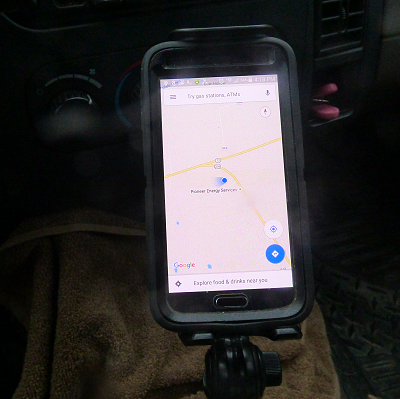
iKross 2-in-1 Tablet and Cellphone Extended Cup Mount Holder
that I got from Amazon on Black Friday.

I got a chance to try it out on our San Antonio Trip yesterday, and I really like it. It’s very sturdy and locks into the cupholder very tightly and will not come out until you release it.
It works both with my tablet to run Waze
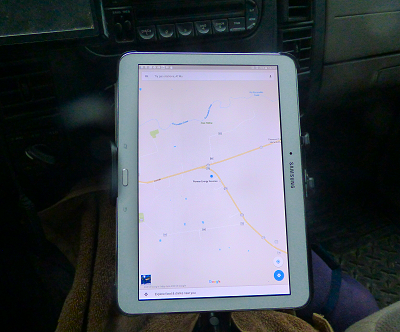
and my cellphone to find local places.
And it even makes a great hat rack.

A Triple Threat.
Thought for the Day:
5 rules of a gun fight:
1) gun beats no gun
2) fast beats slow
3) a hit beats a miss
4) big holes beat little holes
5) two holes beat one hole
fgsdfgsdfg